

Last updated: January 2026
Remote work isn’t going anywhere. Despite the headlines screaming about return-to-office mandates, the data tells a different story: working from home has settled into a new normal that benefits both employees and employers.
Remotive has been monitoring stats on remote work for over ten years now.
Whether you’re job hunting, building a remote team, or just curious about where work is headed, this guide breaks down everything you need to know! Backed by research from Stanford, Harvard, the Bureau of Labor Statistics, and other institutions you can actually trust.
Let’s dive in 👀
Key Remote Work Statistics at a Glance (2026)
Here’s the TL;DR if you’re in a hurry:
| Statistic | Value |
|---|---|
| Americans working remotely | 34.3 mil (22% of workforce) |
| Remote-capable workers currently WFH at least sometimes | 75% |
| Workers who’d likely leave if remote work was eliminated | 46% |
| Remote/hybrid job postings (Q3 2025) | 36% of new jobs |
| US office vacancy rate (Q3 2025) | 18.8% |
| Hybrid work productivity boost | ~5% |
Sources: BLS, Pew Research Center, Robert Half, CBRE, Stanford
How Many People Work Remotely in 2026?
Short answer: About 34 million Americans, or roughly 22% of the workforce.
But here’s what’s interesting… that number has barely budged since early 2023. Stanford economist Nick Bloom, one of the world’s leading researchers on remote work, puts it bluntly: the pandemic-era surge in remote work didn’t disappear. It just stabilized.
According to the Bureau of Labor Statistics, the telework rate has consistently stayed between 18% and 24% since late 2022. This isn’t a trend that’s fading. It’s the new baseline.
And it’s not just an American phenomenon.
The Global Survey of Working Arrangements (a 40-country study of 16,000+ workers) found that English-speaking countries lead the world in remote work adoption:
| Region | Average Days WFH per Week |
|---|---|
| US, UK, Canada, Australia | 1.5–2 days |
| European countries | 1–1.5 days |
| Latin America & Africa | ~1 day |
| Asian countries | 0.5–1 day |
The takeaway? If you’re in an English-speaking country, remote and hybrid work are essentially standard practice for knowledge workers.
If you’re in Asia, not so much. Cultural factors around “face time” still drive people to the office more often.
Sources: BLS Current Population Survey, Stanford G-SWA 2025, Stanford News
What Percentage of Workers Are Hybrid vs. Fully Remote vs. In-Office?
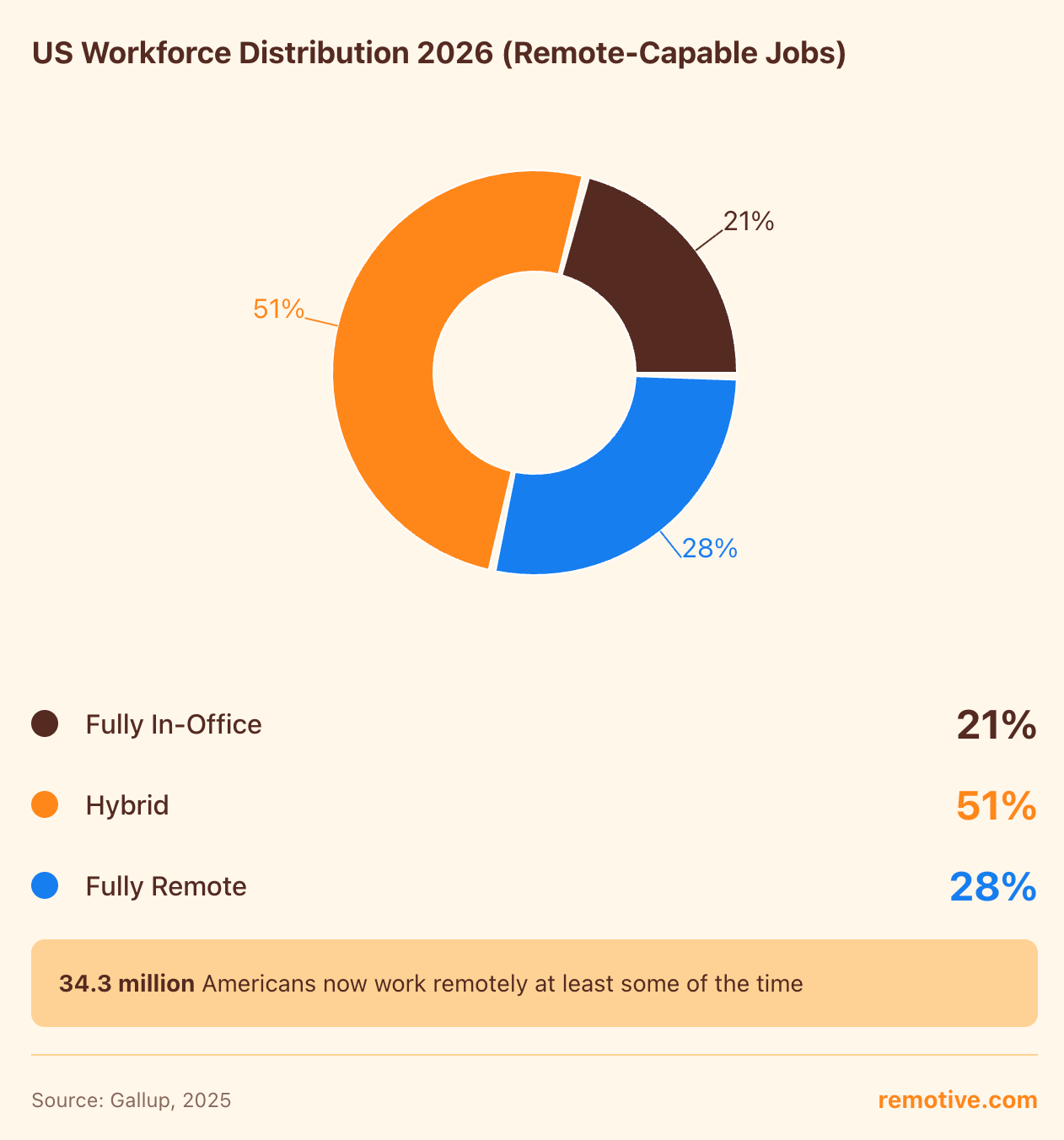
Among workers whose jobs can be done remotely, here’s how it breaks down:
| Work Model | Percentage |
|---|---|
| Hybrid | 51% |
| Fully remote | 28% |
| Fully in-office | 21% |
So hybrid is king. More than half of remote-capable workers split their time between home and office. Typically 2-3 days in each location.
Here’s the thing most RTO headlines miss: work-from-home now accounts for a quarter of all paid workdays among American workers aged 20-64. That’s up from just 5-6% before the pandemic.
The data also shows some interesting demographic patterns:
- Workers with young children (under 8) work from home about 7% more than those without
- Women work from home about 2% more than men
- Parents are more likely to have hybrid arrangements, while non-parents tend to be either fully remote or fully in-office
Sources: Gallup, NBER Working Paper, Stanford G-SWA 2025

Is Remote Work Actually Declining in 2026?
No. Despite what the headlines say.
Yes, Amazon, JPMorgan, and the federal government made waves with return-to-office mandates. But according to Stanford’s research, these dramatic announcements “will barely move the needle on WFH.”
The math is simple: planned RTO mandates across US businesses would only reduce the share of work-from-home days by about 0.5%. That’s… not a revolution.
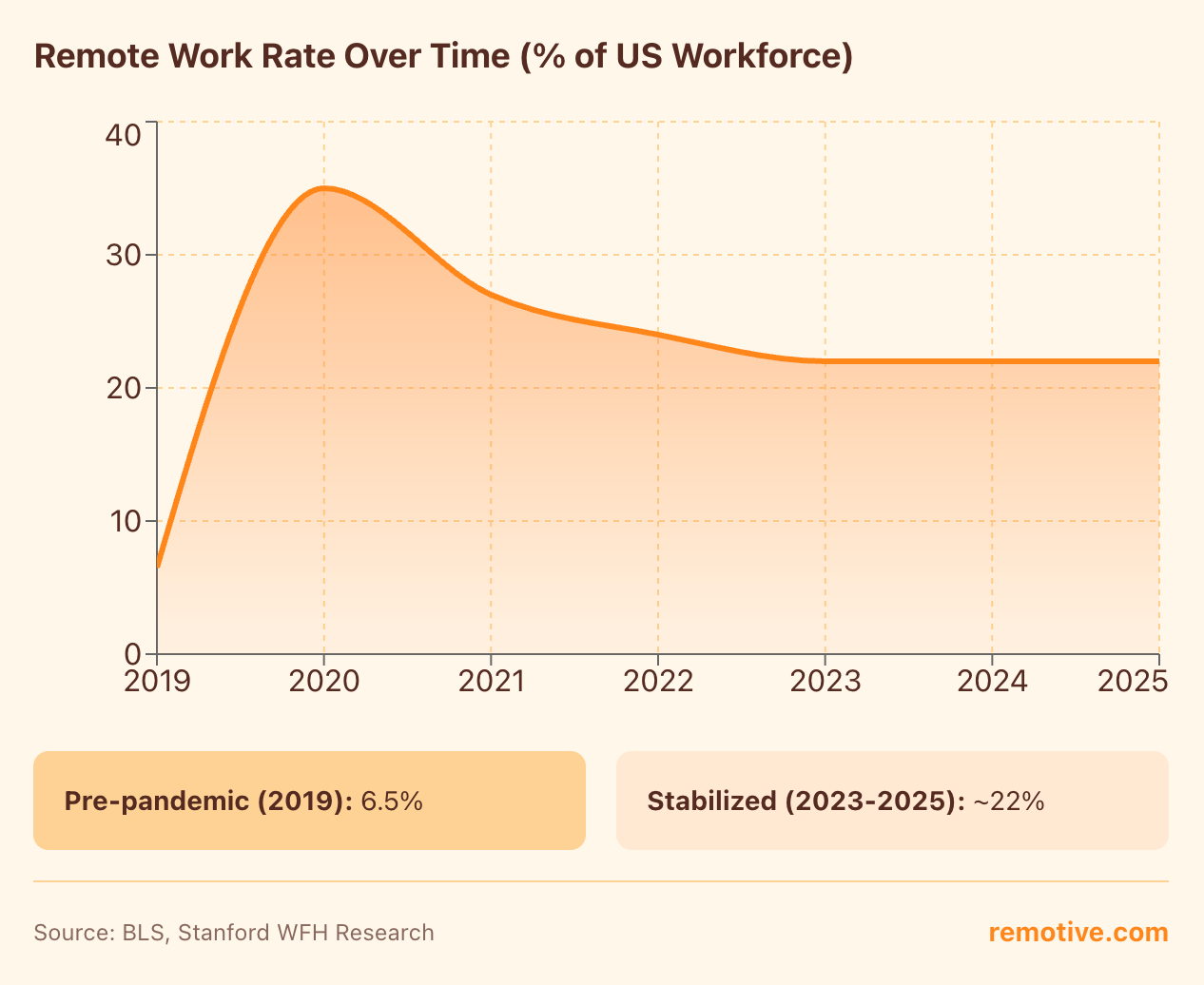
Nick Bloom presented data from three independent sources or surveys, building access records (Kastle), and cell phone tracking (Placer.ai). All showing the same thing: remote workdays have held steady at around 25% of the working week for over two years.
What’s really happening? A few high-profile CEOs are making noise, but 88% of executives with hybrid or remote workers have no plans for a full return-to-office mandate.
The real story isn’t about RTO mandates. It’s about poorly executed ones. Bloom’s research shows that companies mandating random in-office days (without coordinating when teams come in) see terrible results. The organizations getting hybrid right are the ones with clear, structured policies like “everyone in Tuesday through Thursday.”
Sources: Stanford News, Gallup, WFH Research
Are Remote Workers More Productive?
This is the million-dollar question. And the research is surprisingly clear.
Stanford’s landmark Trip.com study (one of the largest randomized controlled trials on hybrid work ever conducted) found:
- Zero performance difference between fully in-office and hybrid workers
- 35% reduction in quit rates for hybrid workers
- Estimated $20 million in annual profit from reduced turnover and office costs
The Bureau of Labor Statistics backs this up with broader data. Their research found that a 1% increase in remote work is associated with.
McKinsey’s analysis found that well-organized hybrid teams are about 5% more productive than their fully remote or fully in-office counterparts. The key word there is “well-organized”. Poorly managed remote work can definitely backfire.
Harvard Business School research adds another wrinkle: productivity perceptions shifted dramatically over time. In early 2020, 70% of small business owners reported a productivity dip from remote work. By 2021, the median business owner reported a positive productivity impact.
Sources: Stanford News, BLS, McKinsey, Harvard Business School
How Much of Your Life Is Spent Commuting?
Here’s a stat that might make you reconsider that office job:
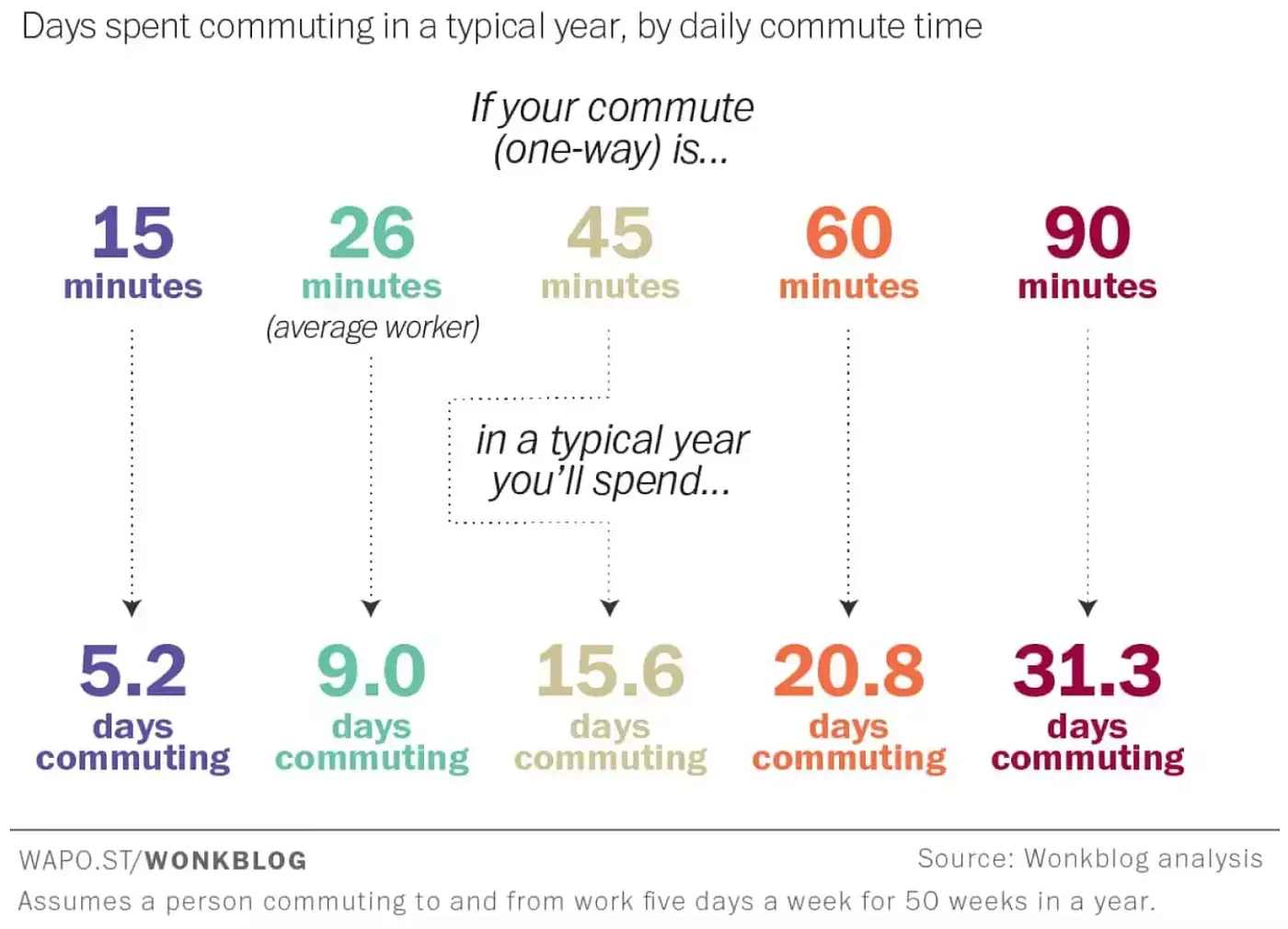
If your one-way commute is the US average of 26 minutes, you’re spending 9 full days per year just getting to and from work. Got a 60-minute commute? That’s nearly 21 days. almost an entire month of your life, every year, sitting in traffic or on a train.
Remote workers save an average of 72 minutes per day on commuting globally (55 minutes in the US). That adds up to roughly two hours per week. Or about 2.2% of a typical workweek.
What do people do with that reclaimed time? According to research from the Federal Reserve Bank of New York:
- 40% goes to extra work (primary or secondary jobs)
- 34% goes to leisure activities
- 11% goes to caregiving
The economic impact is massive. Upwork estimates that since the pandemic began, remote workers who used to drive have collectively saved over $90 billion in commuting costs. That includes direct costs (gas, maintenance) plus externalities like reduced congestion and pollution.
Sources: CEPR/VoxEU, Federal Reserve Bank of New York, Upwork, Washington Post/Wonkblog analysis
How Much Is Remote Work Actually Worth to Workers?
Here’s where it gets interesting: people are willing to pay – literally – for the privilege of working from home.
New research from Harvard Business School’s Zoë Cullen found that tech workers would sacrifice up to 25% of their total compensation to avoid commuting five days a week. At an average tech salary of $239,000, that’s nearly $60,000 they’d give up.
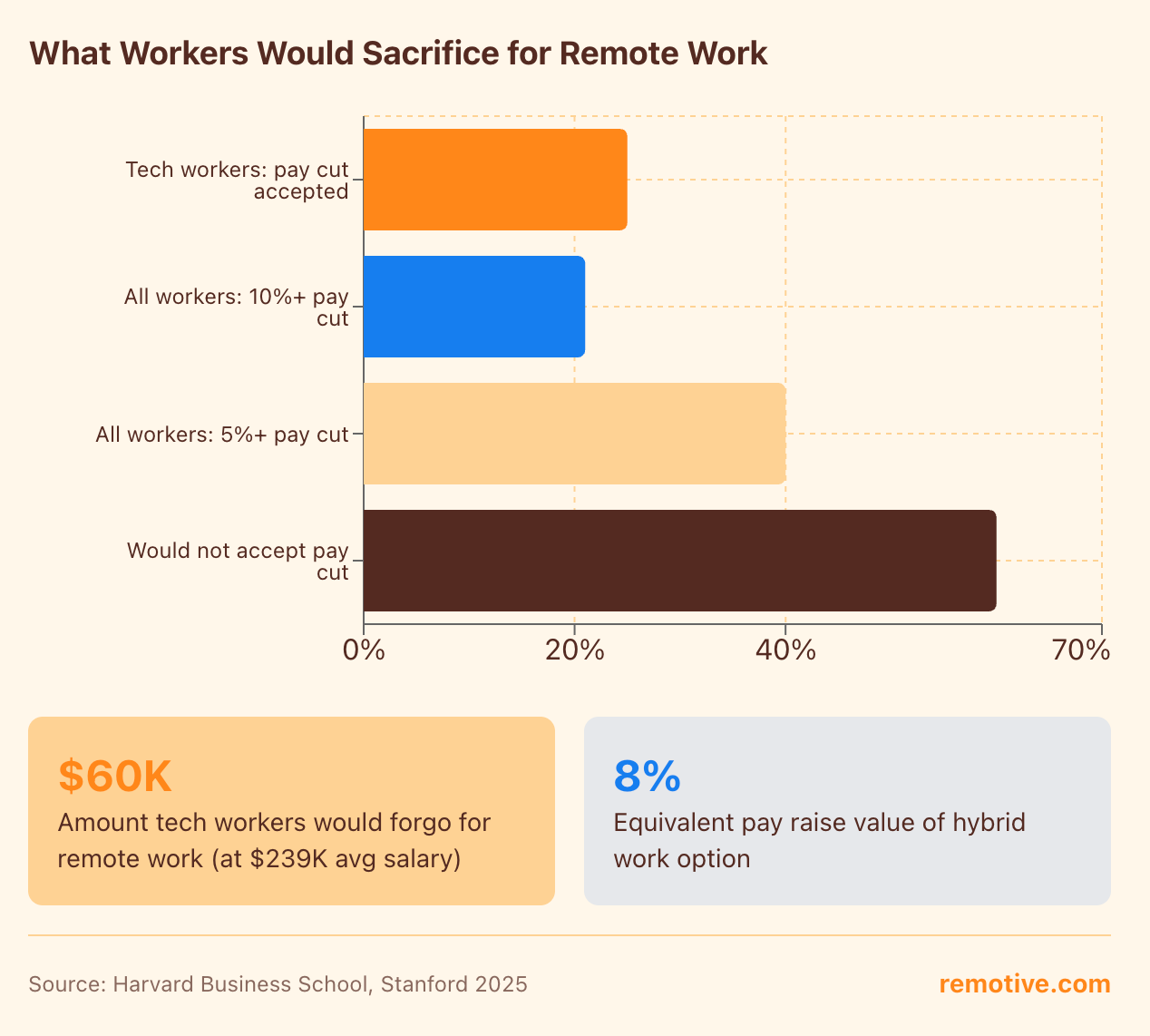
That’s 3-5x higher than previous estimates suggested. Remote work isn’t just a nice perk. For many workers, it’s worth more than a significant raise.
The broader workforce shows similar (if less extreme) preferences:
| Finding | Percentage |
|---|---|
| Would take a pay cut of 5%+ for remote work | 40% |
| Would accept a 10%+ pay cut | 21% |
| Would not accept any pay cut | ~60% |
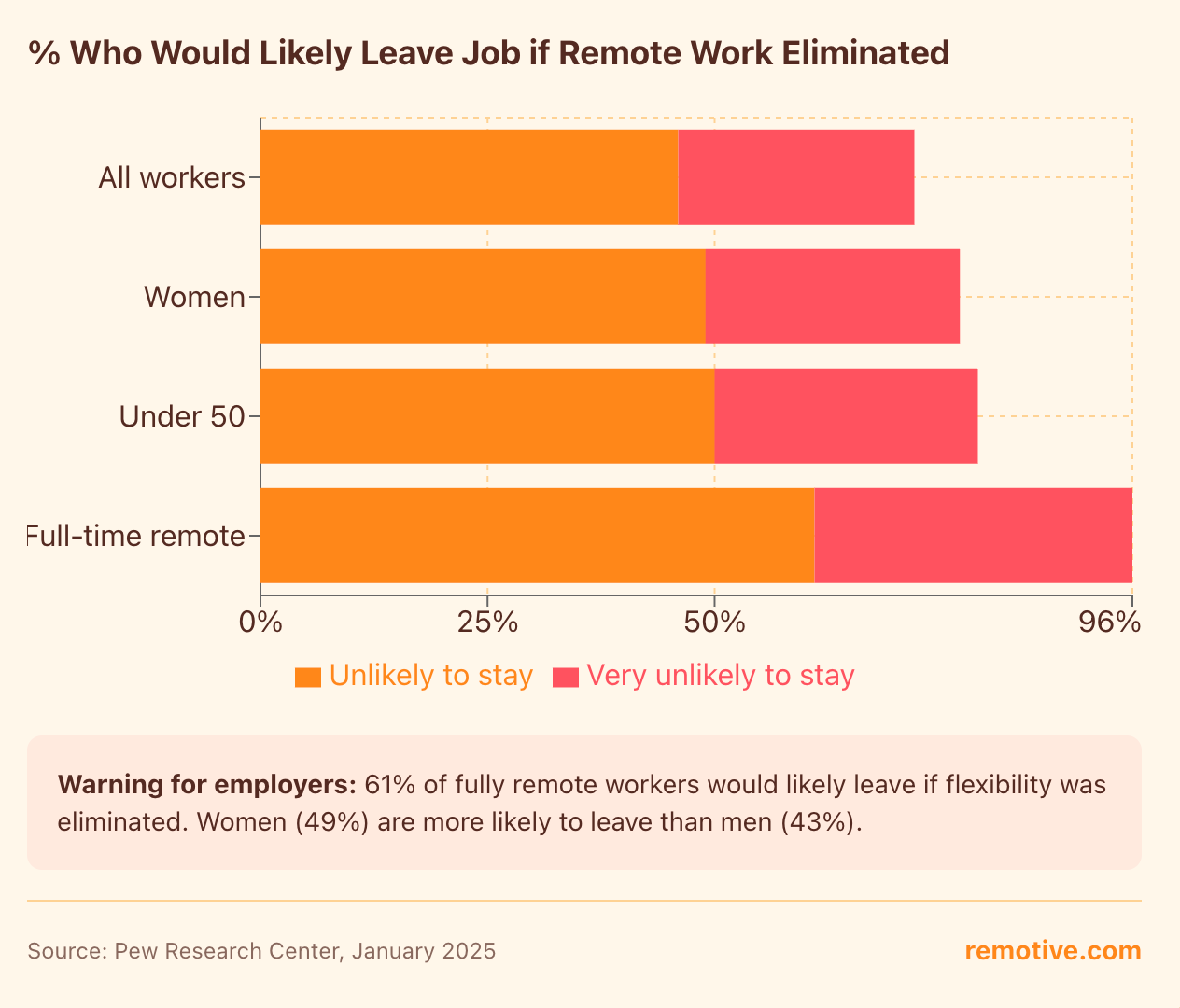
Women are more likely than men to accept significant pay cuts for flexibility, which makes sense given that women with children have the highest desire for WFH arrangements (2.66 days per week on average, according to Stanford’s global survey).
Employees value the option to work hybrid as equivalent to an 8% pay raise. That’s not nothing.
Sources: Harvard Business School, Stanford G-SWA 2025, Pew Research Center
What Happens When Companies Force Employees Back to the Office?
Spoiler: It usually doesn’t go well.
Pew Research Center found that 46% of workers who currently work from home would be unlikely to stay at their job if remote work was eliminated. Among those who work remotely full-time, that number jumps to 61%.
McKinsey’s 2025 survey found that 17% of recent job quitters left specifically because their employers changed office policies. That makes flexibility changes one of the top three triggers for voluntary exits.
Here’s the kicker: intent to leave is roughly the same (38-41%) across in-person, hybrid, and remote workers. The work location itself doesn’t determine whether people want to quit. It’s how well the work is managed.
What about the companies themselves? According to McKinsey’s research across 8,400+ employees:
- There’s no clear winner among work models for employee experience and productivity
- In-person, remote, and hybrid workers report similar levels of burnout, effort, and satisfaction
- The companies that succeed focus on practices (coordination, communication, trust) rather than policies (mandated days in office)
The bottom line: blanket RTO mandates create attrition risk without meaningfully improving outcomes. The companies winning at hybrid are the ones investing in coordination and culture, not counting badge swipes.
Sources: Pew Research Center, McKinsey, Stanford News
Which Industries Offer the Most Remote Jobs?
Not all industries are created equal when it comes to flexibility. Here’s how job postings break down:
| Industry | On-Site | Hybrid | Fully Remote |
|---|---|---|---|
| Technology | 56% | 29% | 15% |
| Marketing & Creative | 55% | 30% | 15% |
| Finance & Accounting | 61% | 26% | 13% |
| Legal | 61% | 30% | 9% |
| Human Resources | 69% | 26% | 5% |
| Admin & Customer Support | 80% | 12% | 8% |
| Healthcare | 80% | 9% | 11% |
Technology leads the pack, with 44% of positions offering hybrid or remote options. Gallup’s data shows that in tech specifically, 47% of remote-capable employees are fully remote and 45% are hybrid. Meaning only 9% are fully on-site.
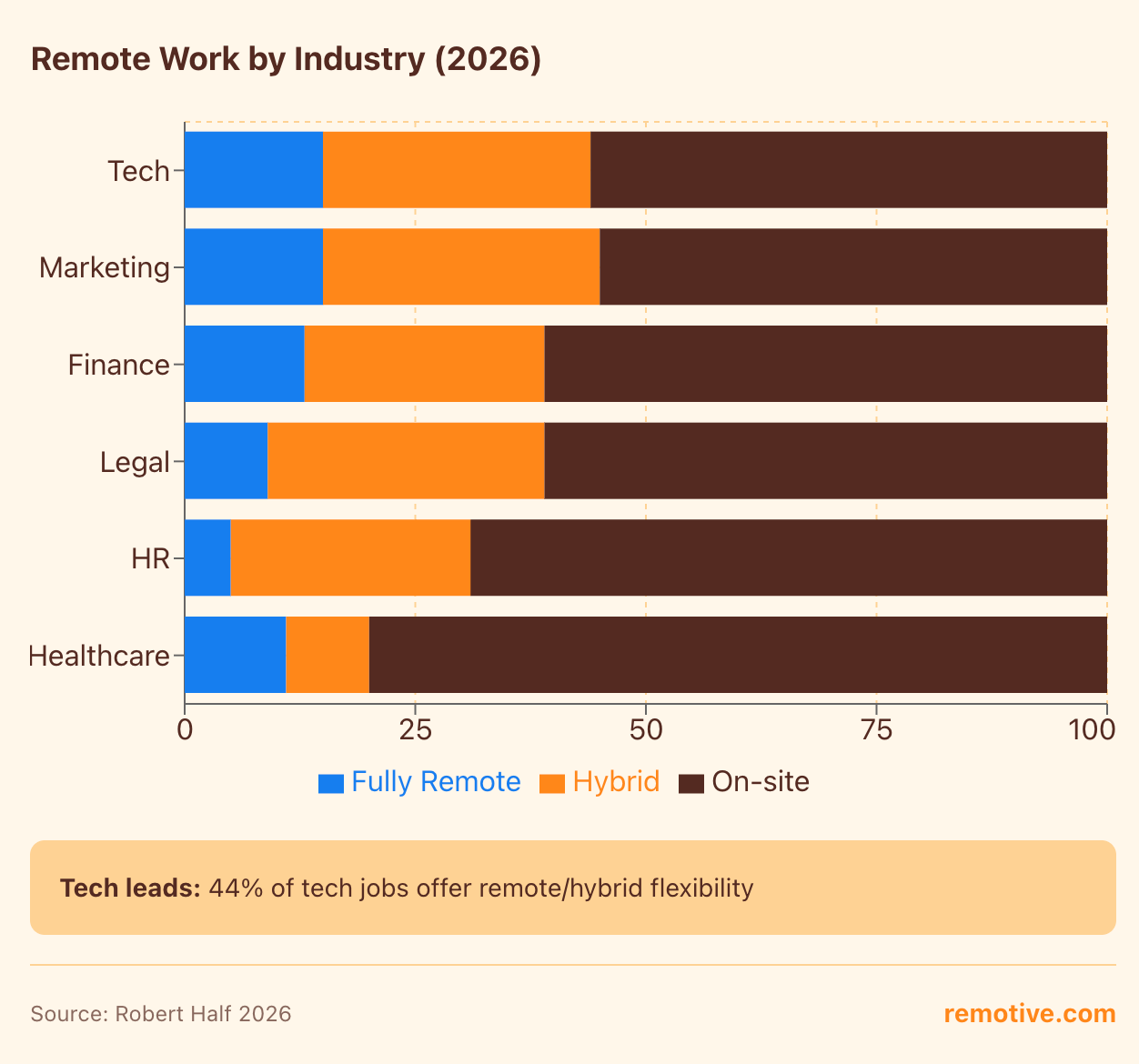
The pattern is clear: knowledge work that happens on a computer tends to be more flexible. Jobs requiring physical presence (healthcare, manufacturing, hospitality) remain predominantly in-person.
If you’re targeting remote work, your best bets are tech, marketing, finance, and legal. If you’re in healthcare or admin, expect fewer options. Though telehealth has opened up more remote opportunities in medical fields than existed pre-pandemic.
Sources: Robert Half Q3 2025, Gallup
How Has Remote Work Affected the Job Market?
The job posting data tells a clear story of normalization:
| Metric | Value |
|---|---|
| Hybrid job postings (Q3 2025) | 24% |
| Fully remote job postings (Q3 2025) | 12% |
| Total flexible postings | 36% |
| Pre-pandemic remote job rate | ~4% |
So about a third of all new job postings now include some remote component. That’s down from pandemic peaks but represents a permanent, massive shift from the ~4% baseline before COVID.
Flexibility also varies by seniority:
| Experience Level | Hybrid | Remote |
|---|---|---|
| Senior roles | 31% | 14% |
| Mid-level roles | 25% | 12% |
| Entry-level | 18% | 10% |
Senior employees have more leverage to negotiate flexibility. Entry-level workers get less. Which creates an interesting dynamic where the people who might benefit most from in-office mentorship have less access to remote options, while experienced workers who need less hand-holding get more flexibility.
Sources: Robert Half, WFH Research

What’s Happening with Office Real Estate?
Remote work has fundamentally reshaped commercial real estate. The data is striking!
The US office vacancy rate hit 18.8% in Q3 2025, according to CBRE. That’s the first year-over-year decline since Q1 2020, but still historically high. For context, this level hadn’t been seen since the savings and loan crisis in 1992.
Here’s the bifurcation that’s reshaping the market:
| Building Type | Vacancy Rate |
|---|---|
| Prime/Class A | 14.2% |
| Non-prime/Commodity | 19.1% |
The gap keeps widening. Companies that do want office space are upgrading to nicer buildings in better locations. Older, commodity office space is struggling. Competing not just with remote work but with 175 million square feet of discounted sublease space on the market.
CBRE projects that prime office vacancy will return to pre-pandemic levels of about 8.2% by 2027. But that recovery won’t extend to lower-quality buildings, many of which face conversion to housing or demolition.
Office attendance remains about 30% lower than pre-pandemic levels, with metropolitan areas like San Francisco, New York, and London showing the biggest drops. Kastle’s building access data shows US office buildings hovering just north of 50% occupancy.
Sources: CBRE Q3 2025, CBRE 2025 Outlook, McKinsey
How Does Remote Work Affect the Environment?
This one’s more nuanced than you might think.
Full-time remote work can reduce an individual’s carbon footprint by up to 54%. That’s huge. But the benefits scale down dramatically:
- 2-4 days remote: 11-29% reduction
- 1 day remote: Only 2% reduction
Why the big drop-off? Cornell and Microsoft researchers found that one-day-a-week remote workers often offset their commute savings by driving more for non-work purposes. The environmental gains only materialize when people genuinely reduce their driving overall and when companies implement office-sharing policies.
The aggregate numbers are still impressive. Upwork estimates post-COVID remote workers are collectively saving 890 million fewer miles traveled per day compared to their previous commutes. That translates to reduced emissions, less congestion, and lower infrastructure wear.
Sources: Cornell/Microsoft PNAS study, Upwork
How Will AI Change Remote Work?
This is the wild card. Nobody knows exactly how AI will reshape remote work, but the World Economic Forum has laid out some scenarios worth understanding.
Current state:
- 88% of businesses now use AI in at least one function (McKinsey)
- AI literacy skill demand increased 70% from 2024-2025 (LinkedIn)
What executives expect:
| Expectation | Percentage |
|---|---|
| AI will displace jobs | 54% |
| AI will create new jobs | 24% |
| AI will increase profit margins | 45% |
| AI will lead to higher wages | 12% |
The WEF’s Future of Jobs Report 2025 projects that global macrotrends (including AI) will create 170 million new jobs by 2030 while displacing 92 million. A net gain of 78 million jobs, but with massive churn.
Four possible futures the WEF outlines:
- Supercharged Progress: AI advances exponentially + workers adapt = new job categories emerge fast, humans become “agent orchestrators”
- Age of Displacement: AI advances exponentially + workers don’t adapt = mass displacement and social fracture
- Co-Pilot Economy: AI advances incrementally + workers adapt = human-AI teams reshape work
- Stalled Progress: AI advances incrementally + workers don’t adapt = patchy gains, inequality widens
For remote workers specifically, AI could be a double-edged sword. On one hand, better collaboration tools could make distributed work even more seamless. On the other hand, if AI can do knowledge work, the geographic arbitrage that makes remote work attractive might matter less.
Sources: WEF Future of Jobs Report 2025, McKinsey State of AI, LinkedIn Economic Graph

Who Works Remotely? (Demographics Breakdown)
Remote work isn’t evenly distributed across the population. Education is the biggest predictor:
| Education Level | Remote Work Rate |
|---|---|
| Bachelor’s degree or higher | 38.3% |
| Some college | 15% |
| High school diploma | 7-9% |
| No high school diploma | 3.1% |
Gender shows smaller but consistent differences:
- Women teleworking: ~25%
- Men teleworking: ~19%
This gap likely reflects occupational sorting (women are overrepresented in some office-based roles that went remote) plus the fact that women with children especially value flexibility.
Age patterns are less dramatic than you might expect. Workers aged 25-54 have the highest telework rates (~25%), while those 16-24 have the lowest (7.9%). The young workers who might benefit from in-person mentorship are actually the least likely to have remote options.
Race shows significant disparities in remote work access:
- Asian workers: 32.8%
- White workers: 23.2%
- Black workers: 17.1%
- Hispanic/Latino workers: 12.4%
These gaps largely reflect differences in occupational distribution, with Asian and white workers more concentrated in knowledge-work roles that are amenable to remote work.
Sources: BLS Telework Trends, Stanford G-SWA 2025
What Do Remote Workers Actually Want?
The data on worker preferences is remarkably consistent:
| Preference | Percentage |
|---|---|
| Want to work remotely for the rest of their career | 98% |
| Prefer hybrid arrangements | 60% |
| Prefer fully remote | 30% |
| Prefer fully on-site | <10% |
Among hybrid workers, only 24% would choose to work from home all the time if given the option. Most (72%) would stick with a hybrid arrangement. People actually want some office time. They just don’t want five days a week of it.
The biggest benefits workers cite:
- No commute (51-60%)
- Savings on gas and lunch (44%)
- Flexible schedule (38%)
- Flexibility to manage time (22%)
- Choice of where to live (19%)
The biggest challenges:
- Staying home too often (21%)
- Difficulty feeling connected to coworkers (53%)
- Loneliness (15%)
- Working across time zones (14%)
That connection challenge is real. More than half of remote workers say working from home hurts their ability to feel connected with colleagues. But here’s the interesting part: despite this, remote workers report similar satisfaction with coworker relationships as in-office workers. They’ve adapted.
Sources: Buffer State of Remote Work, Pew Research Center, Gallup
What Does the Future Hold for Remote Work?
Patent applications for remote work technologies are rising, which typically predicts rapid development in those areas. Better video conferencing, VR collaboration tools, and AI assistants could all make distributed work more seamless.
Near-term projections:
- WFH levels expected to remain stable at ~25% of workdays through 2026
- Prime office vacancy projected to return to pre-pandemic levels (~8%) by 2027
- Hybrid will remain the dominant model for knowledge workers
The WEF projects 90 million global digital remote jobs by 2030. Up significantly from current levels.
What won’t change: the fundamental tension between employers who want visibility and control and workers who value autonomy and flexibility. The companies that figure out how to give employees meaningful flexibility while maintaining coordination and culture will win the talent war. The ones that don’t will keep losing people to competitors who do.
Sources: CBRE 2025 Outlook, WEF
Frequently Asked Questions
How many people work remotely in 2026?
About 34 million Americans (22% of the workforce) work remotely at least sometimes. Among workers with remote-capable jobs, 75% are working from home at least some of the time. This represents a permanent shift from pre-pandemic levels of just 5-6%.
Is remote work declining?
No. Despite high-profile RTO mandates, the share of work-from-home days has held steady at around 25% of all paid workdays since early 2023. Stanford research shows planned RTO mandates would only reduce this by about 0.5%.
Are remote workers more productive?
Generally yes, when well-managed. Stanford’s Trip.com study found zero performance difference between hybrid and in-office workers, with significant cost savings from reduced turnover. McKinsey found well-organized hybrid teams are about 5% more productive than alternatives.
What industries offer the most remote jobs?
Technology leads with 44% of positions offering hybrid or remote options (29% hybrid, 15% remote). Marketing, finance, and legal also offer significant flexibility. Healthcare and administrative roles remain predominantly on-site.
How much do remote workers save?
Workers save an average of 72 minutes per day on commuting globally. Financial savings vary but can reach $4,000+ annually on transportation, food, and work clothes. Stanford research shows employees value hybrid work as equivalent to an 8% pay raise.
What percentage of jobs will be remote in the future?
Current data shows 36% of new job postings include some remote component (24% hybrid, 12% fully remote). The WEF projects 90 million digital remote jobs globally by 2030. Hybrid arrangements are expected to remain the dominant model for knowledge workers.
Sources
Academic Research: Stanford Institute for Economic Policy Research (SIEPR), Stanford News / Nick Bloom Research, Harvard Business School, National Bureau of Economic Research (NBER), Cornell University
Government Data: Bureau of Labor Statistics (BLS), Federal Reserve Bank of New York
Research Organizations: Pew Research Center, Gallup, McKinsey & Company, World Economic Forum
Industry Data: Robert Half, CBRE, Buffer, WFH Research, Upwork