

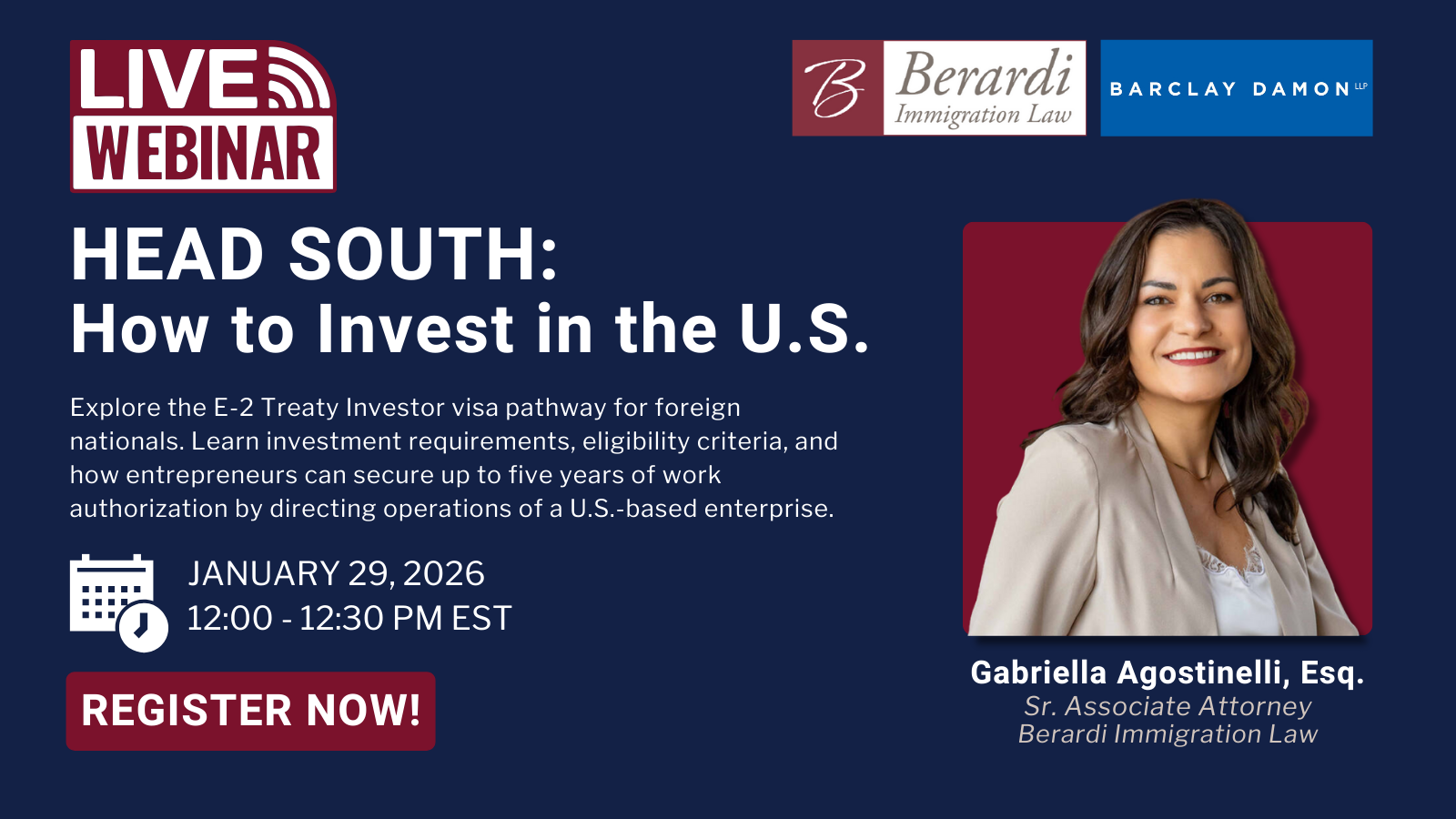
Transcript:
Hi everyone,
I’m Gabriella Agostinelli with Berardi Immigration Law, and today we’re talking about the E-2 visa.
As I sit here in snowy Buffalo, New York, I want to remind you: if you’re a Canadian (or from anywhere else in the world) and you dream of moving to sunny Florida, Arizona, or California, it is possible. That’s what we’re discussing today, how to move to the United States by starting or purchasing a business here, using the E-2 Treaty Investor Visa.
Why is it called the “Treaty Investor” visa?
It’s called a Treaty visa because it’s only available to citizens of countries that have a treaty of friendship and commerce with the United States. For example, Canada has a qualifying treaty, so Canadians are preliminarily eligible.
It’s called an Investor visa because it requires that you have invested money into either:
-
an existing U.S. business you purchased, or
-
a new U.S. business you started.
One of the first questions people ask is: How much do I have to invest? We’ll get there, but first, let’s cover the general requirements and what the government is looking for.
General Requirements
The E-2 Treaty Investor Visa can be a great option for people looking to make a new start in the U.S. Some clients are already entrepreneurs and may even have existing businesses. Others are starting from scratch.
Either way, the government wants to see that you have experience in the field of the business you’re starting or buying. You might have worked in the industry and are ready to start your own operation, or you might have run a similar business abroad and want to replicate that success in the U.S.
Most importantly, we need to show that you have the ability to develop and direct the business.
Proving the Investment
A major part of an E-2 case is documenting the investment. We need to carefully evidence every step, including:
-
Lawful source of funds
The government wants to ensure the money came from a legitimate source, no money laundering or illegal activity. They’ll ask: Where did the money come from? Was it from the sale of property? Business income? An affiliated company abroad? We must document the source. -
Transfer of funds to the U.S.
We also need to show how the money moved from your home country to the U.S. through wire transfers, bank statements, and other documentation proving it was transferred properly. -
Irrevocably committed (spent) funds
We must show the money has been “irrevocably committed,” meaning it has actually been spent. You can’t simply transfer money into a U.S. account and ask for a visa. The government wants to see real financial commitment—contracts, invoices, receipts, bills, and credit card statements showing the funds were used.
This can feel uncomfortable because it can seem like putting the cart before the horse. But the reality is: you generally won’t get the visa unless you can show you have real skin in the game.
How much do you have to invest?
The regulations do not provide a specific dollar amount. Instead, it’s based on proportionality, what investment makes sense for the type of business you’re starting or purchasing.
For many clients, $70,000 to $80,000 can be enough. $100,000 is common in many cases. But if you’re starting something capital-intensive, like a manufacturing plant, you may need a much higher investment, potentially $1 million or more.
It depends on the nature of the business and what it realistically takes to get it running.
Business plan and job creation
A key part of the E-2 is showing you’re bringing investment and jobs to the U.S. economy.
To support that, we typically include a robust business plan that outlines:
-
market analysis
-
long-term goals and objectives
-
five-year financial projections
-
hiring projections
-
profit and loss expectations
The government wants to see you’ve thought it through and that you have a plan to grow. The E-2 is not meant to be a way to open a business where you’re the only employee and the business doesn’t substantially grow. They want growth in revenue, headcount, and community impact.
The E-2 process (especially for Canadians)
The process can vary depending on the country, but for Canadians, a common approach is:
-
We submit a portion of the application materials to the U.S. Department of State / the U.S. consulate (for Canada, typically the U.S. consulate in Toronto), summarizing the core case: what the business is, where the investment came from, how it was transferred, how it was spent, the applicant’s background, and business plan excerpts.
-
Once the consulate reviews it, they instruct us to schedule a visa interview.
-
At the interview, you bring a full binder of supporting documents.
-
The interview itself is usually short, often ten minutes or less, and is not typically a long, sit-down interview.
-
If approved, the consulate usually keeps your passport for about five to eight business days to place the visa inside, then returns it by courier.
-
Once you have the visa, you can enter the U.S. and begin working.
Visa validity vs. admission period
In Canada and many other countries, the E-2 visa can be issued for five years. You can often renew it, as long as you continue to meet eligibility requirements and can show the business is growing.
However, having a visa valid for five years does not mean you are admitted to the U.S. for five years at a time.
With investor visas, you are typically admitted for two years per entry. That means you must carefully track your entry and expiration dates, exit and re-enter when appropriate, and avoid overstaying. Admission can also be impacted by the validity of your passport and other documents.
How do you get a green card from E-2?
This is a common question, and it can be trickier.
There are multiple routes to a green card (family-based options, for example). But assuming you’re looking at employment-based routes:
-
The most common employment green card process is PERM, where an employer tests the labor market and sponsors you.
If you own the E-2 business, you generally can’t use PERM because it’s considered self-employment.
Other possible alternatives include:
-
Multinational Manager/Executive green card (if you have an affiliated business abroad and qualify)
-
National Interest Waiver (NIW) (if your business strongly aligns with U.S. national interests)
-
EB-5 investor green card (for larger investments and job creation, often $1 million+ depending on the case)
Closing
In short, the E-2 Treaty Investor Visa is a great way to move to the United States. For some people, it can provide a longer-term pathway, and for many, it offers the ability to live and work in the U.S. for years, as long as you continue meeting the core expectations of the E-2 category: investment, job creation, and business growth.
If you have any questions, please don’t hesitate to reach out. Our attorneys are well-versed in the E-2 visa category, and this is a major part of our practice. We’d be happy to help.
Take care.